This is a first-hand account of how Jeevan AI, a bootstrapped GEO platform with zero paid marketing and a new domain, was compared favorably to a funded competitor by ChatGPT on content quality and topical authority. The findings are directly applicable to any B2B SaaS team trying to build AI visibility without an enterprise content budget.
The question someone typed into ChatGPT was simple: "which is better?" The context was AI search visibility content. ChatGPT pulled both Jeevan AI and a well-funded competitor into its analysis, evaluated both on their content strategies, and gave a verdict.
For content quality per article, ChatGPT leaned toward Jeevan AI.
That is a sentence worth sitting with. We have not run a single paid campaign. We have not issued a press release. We have not paid for link building or sponsored placements. Our domain did not exist before 2025. And yet ChatGPT's analysis placed us alongside a competitor with significantly more funding, more team members, and more years of publishing.
This is not a victory lap. It is a data point. And it is one that directly challenges the assumption most B2B SaaS teams make when they look at a funded competitor's content volume and conclude they cannot compete.
What ChatGPT Actually Said
Here is the analysis as ChatGPT produced it, reproduced accurately:
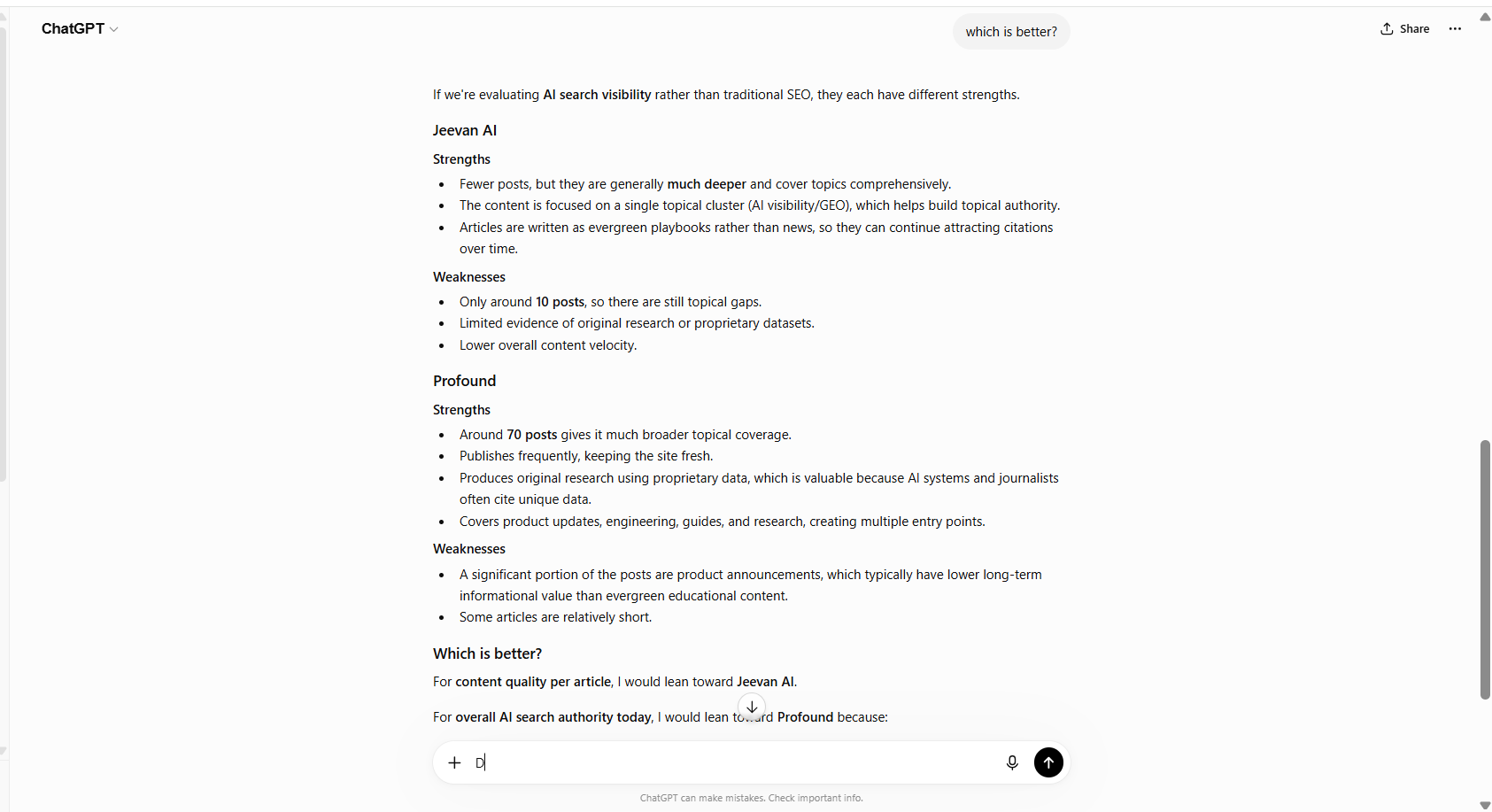
- Fewer posts, but they are generally much deeper and cover topics comprehensively.
- The content is focused on a single topical cluster (AI visibility/GEO), which helps build topical authority.
- Articles are written as evergreen playbooks rather than news, so they can continue attracting citations over time.
- Only around 10 posts, so there are still topical gaps.
- Limited evidence of original research or proprietary datasets.
- Lower overall content velocity.
The competitor was credited with broader topical coverage, higher content velocity, and original research using proprietary data. ChatGPT leaned toward them for overall AI search authority in the short term on the basis of scale.
Both assessments are accurate. We have fewer posts. We do not yet have proprietary datasets published as original research reports. Those are real gaps. But the quality assessment — that what we publish is genuinely deeper and more comprehensively useful — is something we have worked deliberately to earn.
What We Actually Did
There was no content agency. No paid writers producing five posts per week. No link-building campaign or domain authority acquisition strategy. The entire content approach was built around one question: if a B2B SaaS founder asks ChatGPT or Perplexity about AI search visibility, what would the ideal answer look like?
Every article we published was written to answer a specific, real buyer question that we had verified people were actually asking. Not keyword research producing a list of high-volume targets, but direct observation of the questions B2B SaaS teams ask when they discover their brand is missing from AI answers.
The structural decisions we made in every article:
- Lead with the direct answer, not the context-setting preamble
- Use FAQPage schema on every post so question-answer pairs are explicitly extractable
- Stay within the AI visibility and GEO topical cluster — no adjacent content diluting the entity profile
- Write at 1,000 to 1,200 words with real substance, not padding to hit a word count
- Include comparison tables, diagnostic frameworks, and checklists that give readers something to act on immediately
- Name specific tools, specific timelines, specific metrics — not generic advice dressed up as expertise
These are not novel ideas. They are the GEO principles we document in our own guides. The interesting data point is that applying them consistently, without any marketing investment, was sufficient for an AI model to form a positive quality judgment about our content within months of the domain going live.
What This Actually Proves About AI Search in 2026
The conventional wisdom in content marketing is that domain authority, backlink volume, and publishing velocity are the primary drivers of content reach. That framework is a Google Search framework. It does not map cleanly onto how AI models evaluate content.
ChatGPT did not evaluate our domain age. It did not count our backlinks. It evaluated what our content actually says and how well it answers the questions buyers ask. The signals it extracted were:
| Signal ChatGPT Used | What It Looked Like in Practice | What We Did |
|---|---|---|
| Topical coherence | "Focused on a single topical cluster" | Every post within AI visibility/GEO only. No lifestyle, no news, no off-topic content. |
| Content depth | "Generally much deeper and cover topics comprehensively" | 1,000 to 1,200 words per post, structured with H2/H3, comparison tables, FAQ sections. |
| Evergreen utility | "Written as evergreen playbooks rather than news" | No news posts, no trend commentary. Every post answers a durable buyer question. |
| Citation longevity | "Can continue attracting citations over time" | Playbook format with schema markup ensures extractability for retrieval-based engines. |
The weaknesses ChatGPT identified are equally instructive. "Limited evidence of original research or proprietary datasets" is the gap between where we are and where a well-resourced competitor can go. Publishing survey data, running structured experiments, and reporting findings with unique numbers is the layer of content that builds citation authority at scale. It is the next frontier for AI visibility, and it requires more infrastructure than a focused writing practice alone.
The implication for any B2B SaaS team reading this: you do not need to outpublish a funded competitor to be recognized by AI models as a quality source. You need to outspecialize them within your most important topical cluster. Depth within a niche is accessible to a bootstrapped team. Breadth plus proprietary data is not.
The Gap That Still Exists — and Why We Are Saying It Directly
ChatGPT's assessment was not an unqualified win. For overall AI search authority, the competitor with 70 posts, frequent publishing, and proprietary research data was rated higher. That verdict is fair.
Content volume compounds over time. A brand with 70 posts today will have 140 posts in a year. Each new post covers a topical gap, reducing the queries where competitors have an answer and the publishing brand does not. Original proprietary research — surveys, data studies, product usage analysis — creates citations that no amount of well-written explanatory content can replicate. When journalists, analysts, and industry publications quote your data, AI models inherit that citation signal.
These are structural advantages that come with funding and time. We are not pretending they do not exist.
What this case study proves is that the gap is narrower than most bootstrapped teams assume, and the entry requirement is lower than it looks. Getting into the ChatGPT conversation at all, being named in the same analysis as a funded competitor, and winning the per-article quality assessment without a single paid promotion — that is achievable with focused, principled content work. It is the foundation. The proprietary research layer builds on top of it.
What This Means for Your Brand
If you are a B2B SaaS team looking at a competitor with significantly more content, more backlinks, and more marketing budget, the lesson is not "we cannot compete on AI search." The lesson is: pick your topical cluster, go deep within it, and build the content infrastructure that makes your brand the most comprehensively useful source in that specific niche.
That is a winnable game for teams without enterprise content budgets. AI models reward specificity and extractability more than they reward volume. The brands that understand this early are the ones that get into the conversation before the funded competitors have finished building their advantage.
The window is open right now. In most B2B SaaS niches, no brand has built the kind of deep topical authority in AI search that makes the conversation closed. The model that governs AI recommendations is still being shaped by the content being published today.
You can see how we approach this systematically using our 25-point AI visibility checklist, and understand the specific content structure decisions that produce AI-extractable content in our guide on writing content that AI will actually cite. If you want to understand why your brand specifically is not appearing in AI answers, the 6 root causes diagnostic is where to start.
Frequently Asked Questions
Can a new domain with no marketing budget appear in ChatGPT recommendations?
Yes. A new domain with no marketing budget can appear in ChatGPT recommendations if it builds deep topical authority in a specific niche rather than publishing broadly. ChatGPT evaluates content based on depth, extractability, and topical coherence. Jeevan AI achieved favorable comparison against a funded competitor in ChatGPT without spending on paid promotion, by focusing exclusively on the AI visibility and GEO topic cluster and publishing comprehensive structured articles that directly answer buyer questions.
Does content volume or content depth matter more for AI search visibility?
For early-stage AI search visibility, content depth matters more than content volume within a focused topical cluster. ChatGPT's analysis of Jeevan AI versus a competitor with three times the post count awarded Jeevan AI the win on content quality per article, noting that focused topical clusters and evergreen playbooks produce better citation value than high-volume mixed content. At high volume, a competitor with both depth and breadth will win. But for a new brand competing against established players, deep focused content is the highest-leverage starting point.
What did ChatGPT say when comparing Jeevan AI to a funded competitor?
ChatGPT described Jeevan AI as having fewer posts that are generally much deeper, focused on a single topical cluster which helps build topical authority, and articles written as evergreen playbooks. For content quality per article, ChatGPT leaned toward Jeevan AI. For overall AI search authority today, ChatGPT leaned toward the competitor due to broader coverage and more frequent publishing. The weaknesses identified were limited original proprietary research data and lower content velocity — both accurate observations.
What is topical authority and why does it matter for AI visibility?
Topical authority is the degree to which a domain is recognized as a comprehensive expert source on a specific topic cluster. For AI visibility, it matters because AI models build brand entity profiles from patterns they observe in content. A brand with 60 articles all focused on AI search visibility signals specialized expertise. A brand with the same number spread across 20 topics signals generalism. When a buyer asks ChatGPT about AI search visibility, the model is more likely to recommend the specialized source because deep topical coherence creates stronger entity confidence.
The Takeaway Is Simple
We did not beat a funded competitor on AI search authority. We got into the conversation, earned a quality win, and identified exactly where the gap is. That is a realistic starting position for any bootstrapped B2B SaaS team trying to build AI visibility against better-resourced competition.
The strategy that got us here is not proprietary or complex. Write deep, structured, schema-marked content within a focused topical cluster. Answer real buyer questions directly. Do not dilute the entity profile with off-topic content. Publish consistently, not at volume.
And then build the original research layer. That is what closes the remaining gap. Not more posts — more data.
Jeevan AI runs the same analysis across ChatGPT, Perplexity, and Gemini — and tells you exactly what to fix.